
SCIENCE & TECHNOLOGY
From biochar science to fertilizer engineering.
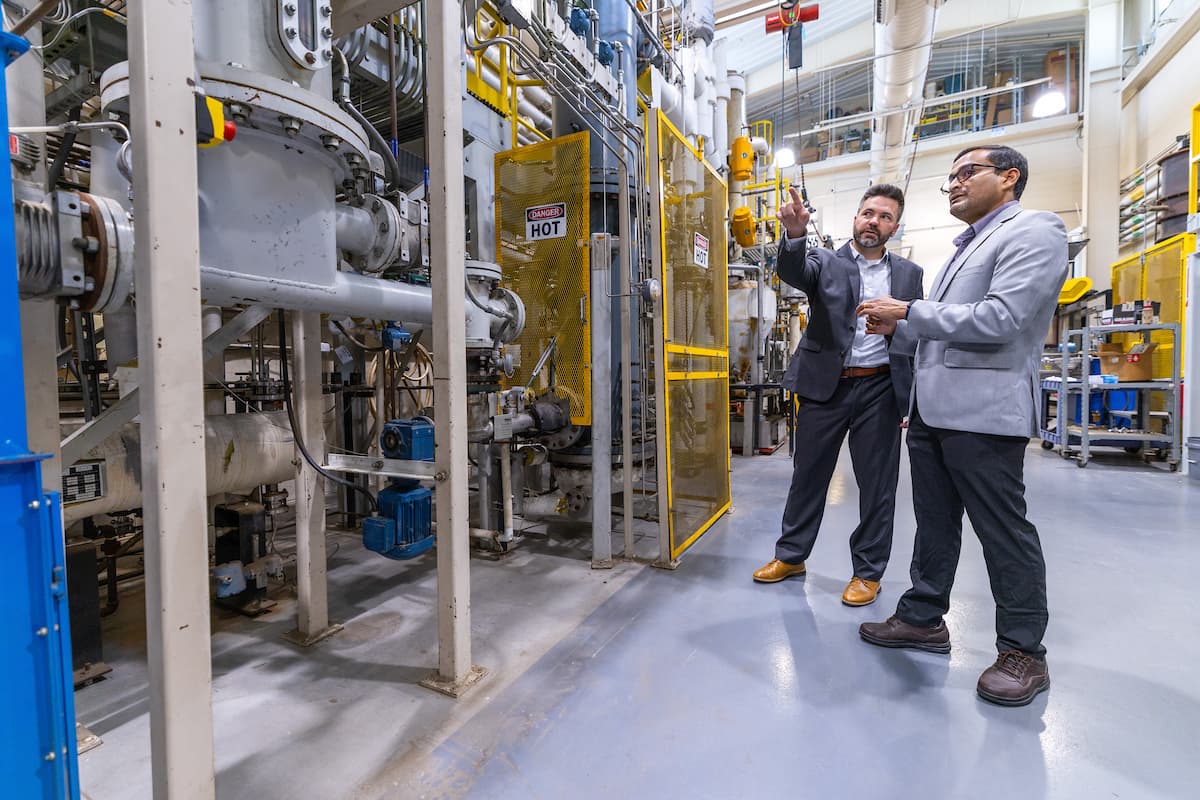
Reform Bio builds on years of Iowa State University research into how engineered carbon surfaces can capture, retain and release crop nutrients. Today, we advance that science into practical fertilizer products designed for real agricultural systems.
THE RAW MATERIAL
Useful carbon starts with what other industries leave behind.
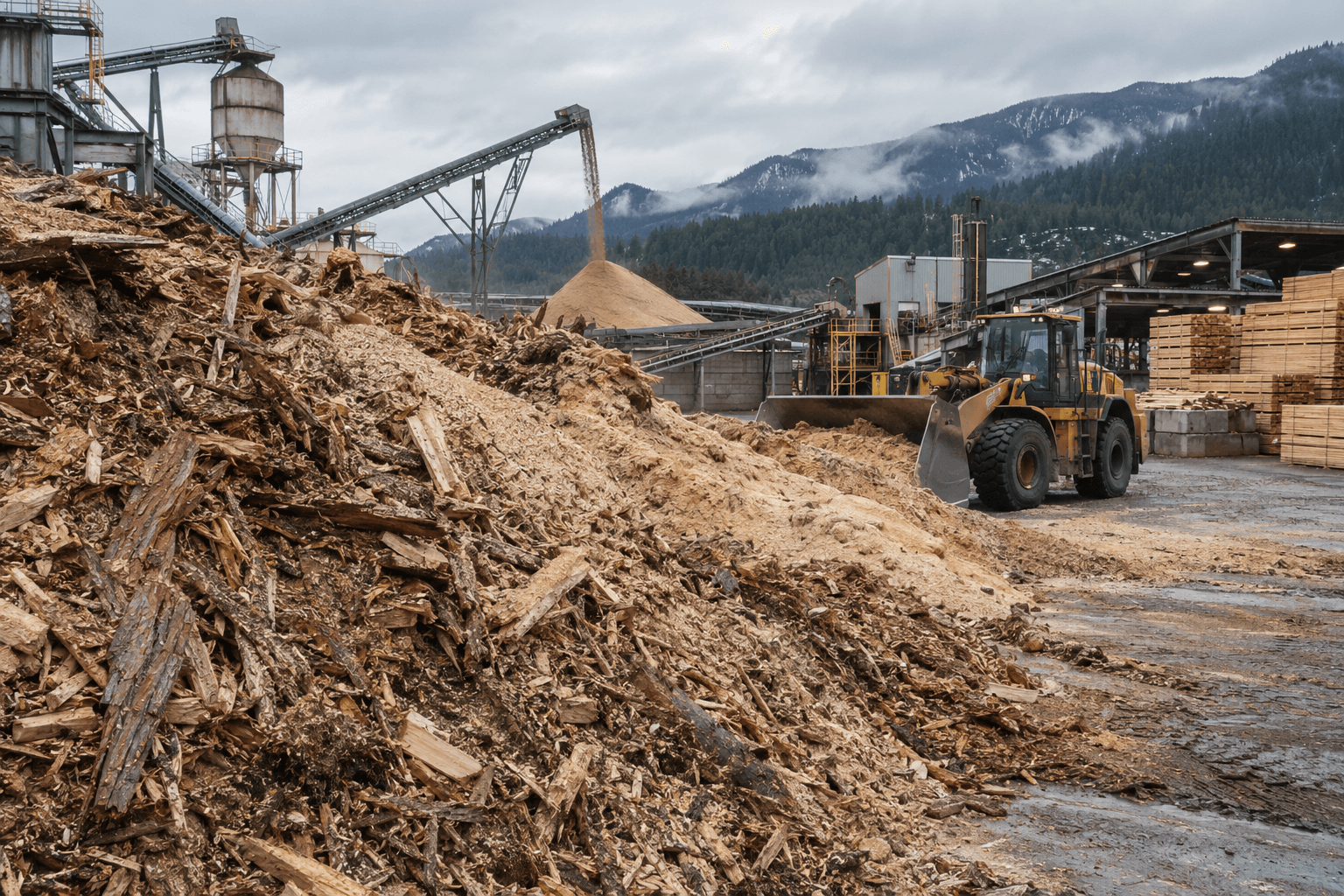
Reform Bio evaluates carbon-rich residual feedstocks from forestry, agriculture, and food processing: wood residuals, oat hulls, sugarcane bagasse, rice hulls, and corn stover. Feedstock choice affects mineral composition, ash content, pore development, carbon structure, and surface chemistry, and not every feedstock is currently used in every product.
BIOCHAR 101
Carbon with structure.
Biochar is a carbon-rich material created by heating biomass in an oxygen-limited environment through a thermal process called pyrolysis.

Underused organic material from forestry, agriculture, and food processing provides the starting carbon source.

Controlled thermal processing in an oxygen-limited environment converts biomass into a stable, carbon-rich material.

The result is a porous, carbon-rich matrix with a reactive surface: structure a fertilizer can build on.
Raw biochar is where Reform Bio starts. It is not where we finish.
THE REFORM BIO PLATFORM
We engineer the carbon surface around the nutrient.
Reform Bio uses proprietary, product-specific activation and formulation methods to modify how the carbon surface interacts with nutrients, for our fertilizer products.
Biochar
Our first building block for our fertilizer formulas is the biochar we create. Not all biochar is created equal, we select the proper feedstock and thermal processing techniques to engineer our SRF and EEF formulas.
Engineered to Outperform Traditional N,P,K Products
Surface functional groups are developed to increase reactivity and surface charge.
Nutrients associate with the activated surface through adsorption, pore infusion, ionic interaction, and hydrogen bonding.
Product-specific formulation tailors the activated material to the nutrient system being delivered.
Surface association regulates how and when the nutrient becomes available again.
PRODUCT-SPECIFIC ENGINEERING
One carbon platform. Different nutrient chemistry.
Reform Bio tailors surface treatment and formulation to the nutrient system being delivered.

Nitrogen
Nitrogen is highly mobile and easily lost. Published Iowa State research showed that activated biochar can associate with urea and slow how quickly nitrogen is released.

Phosphorus
Phosphorus behaves very differently from nitrogen. Reform Bio engineers surface chemistry around phosphate retention and controlled release, helping keep more phosphorus in a form that can remain useful to the crop.
Potassium
Potassium gets its own formulation strategy. We design around its solubility and movement in soil rather than forcing nitrogen or phosphorus chemistry onto a different nutrient.

Organic Nutrient Systems
We concentrate manure-derived nutrients into predictable dry fertilizers, separating N/K from phosphorus so growers can apply each nutrient independently based on crop and soil needs.
RESEARCH ORIGINS
Built from Iowa State research.

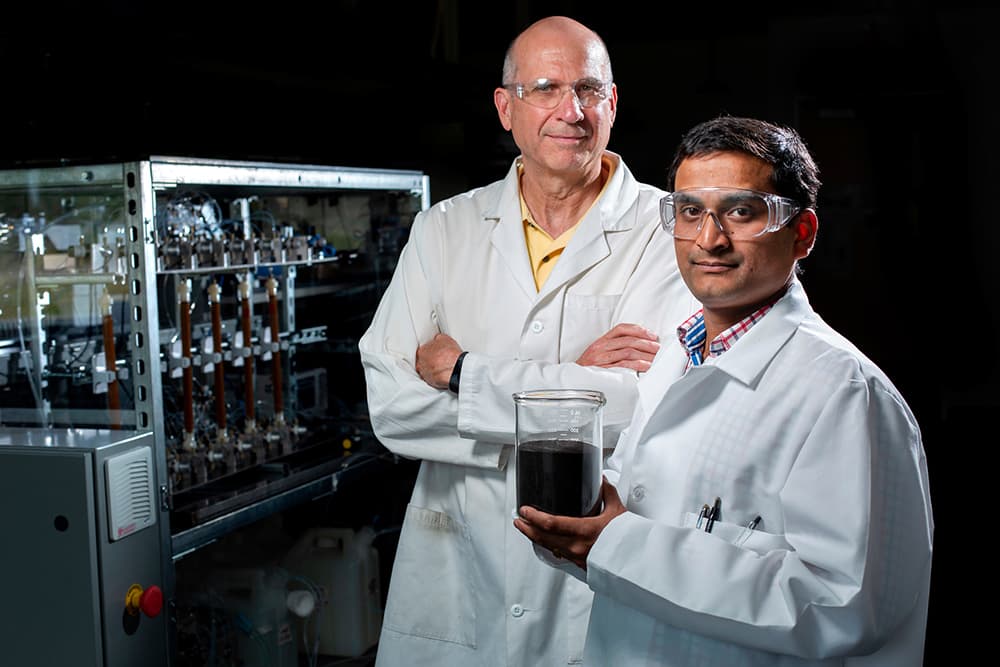
Santanu Bakshi, PhD: Co-Founder, Reform Bio; Principal Scientist, Iowa State University Bioeconomy Institute; Adjunct Assistant Professor, Agricultural and Biosystems Engineering.
Santanu brings more than a decade of research in biochar, nutrient adsorption, surface modification, and slow-release fertilizer systems. Reform Bio's slow-release and enhanced efficiency fertilizer formulas began before 2019 and continue that research lineage today through Iowa State research environments including BioCentury Research Farm and Agronomy Research.
PEER-REVIEWED RESEARCH · 2021
Looking at the nutrient-carbon interaction itself.
Published Iowa State research investigated how urea interacts with activated carbon surfaces and how those interactions alter release, characterized via SEM–EDS, XRD, FTIR, and XPS. The study found evidence of successful urea grafting to activated biochar.
Published research-platform formulation; not the current Nitrogen Reformed V1 commercial formula.
SLOW-RELEASE FERTILIZER
Primary Mode of Action
Illustrative mechanism diagram (not a reproduction of the published figure)
Researchers characterized how urea associates with activated biochar surfaces and found evidence of grafting by creating a chemical bond between the nitrogen and biochar, not just physical mixing, confirmed via SEM–EDS, XRD, FTIR, and XPS testing.
Urea release rate: aqueous laboratory test
Experimental biochar-based SRFs released urea substantially more slowly than uncoated urea.
| Series | Value |
|---|---|
| Experimental biochar-based SRF | 61–90% released over 4,320 min (~3 days) |
| Uncoated urea | 99.6% released in 12 min |
Source: ACS Sustainable Chemistry & Engineering, Published aqueous-release laboratory test, 2021
Enhancing Biochar as Scaffolding for Slow Release of Nitrogen Fertilizer, ACS Sustainable Chemistry & Engineering, 2021
VALIDATION
No single experiment answers every question.
Iowa State Bioeconomy Institute and Reform Bio have taken a comprehensive approach to R&D and ongoing validation using the following methods to guide our science and product development.
Did we change the material?

How quickly does the nutrient become soluble?
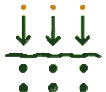
Where does the nutrient move with water?
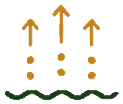
How much nitrogen leaves through the air?

Can the plant access the nutrient?

Does it perform under real weather, soils, and management?

Does performance translate across growing environments?
PEER-REVIEWED RESEARCH · 2023
From nutrient release to plant response.
Published Iowa State greenhouse research tested biochar-to-urea SRF formulations against conventional nitrogen sources in maize.
PEER-REVIEWED · GREENHOUSE STUDY · NOT A COMMERCIAL PERFORMANCE GUARANTEE
Experimental Design
Shoot biomass
Higher than traditional comparators
Source: Journal of Environmental Quality, Greenhouse maize study, 2023
Root biomass
Higher than traditional comparators
Source: Journal of Environmental Quality, Greenhouse maize study, 2023
Nitrogen recovery efficiency
Higher than traditional comparators
Source: Journal of Environmental Quality, Greenhouse maize study, 2023
The study also reported reduced nitrate leaching under tested greenhouse conditions. Its own authors concluded that field research was still needed. That is where Reform Bio's continuing validation picks up.
Impact of biochar-based slow-release N-fertilizers on maize growth and nitrogen recovery efficiency, Journal of Environmental Quality, 2023
FIELD-SCALE RESEARCH
Moving nutrient science into the field.
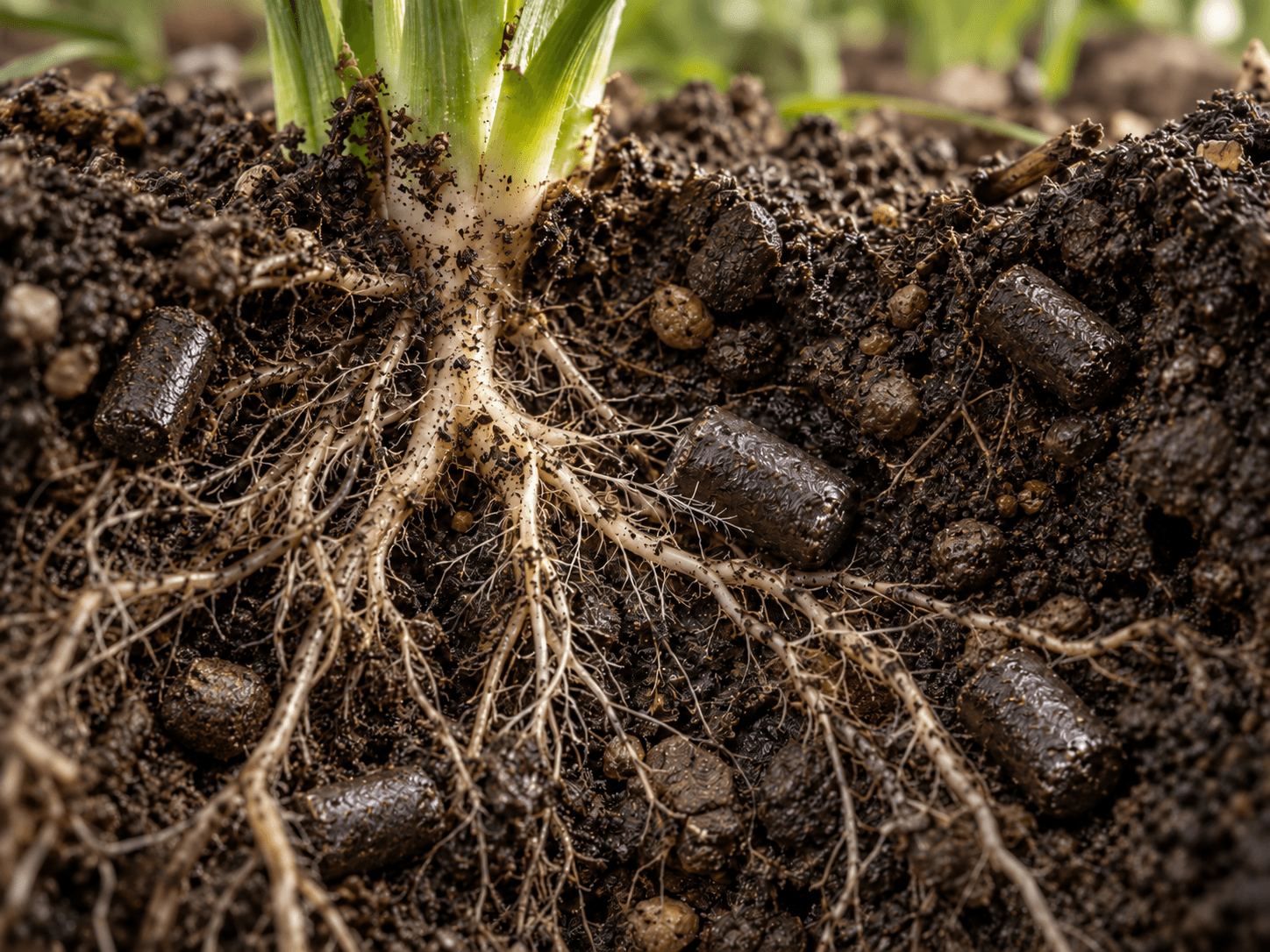
USDA Agricultural Research Service cooperative field research in Iowa is evaluating fertilizer pellets made from biochar and swine manure against conventional fertilizer systems.
Approved research context: two central-Iowa field environments and soil types, multiple nitrogen rates, crop and soil measurements, resin lysimeters, and nitrogen and phosphorus movement and loss measurement.
This work belongs to the research lineage behind Reform Bio's organic nutrient platform.
CONTINUING VALIDATION
Different soils. Different weather. Same questions.
Iowa
Iowa State UniversityContinuing technology development and validation through Iowa State research environments including BioCentury Research Farm and Agronomy Research.
North Dakota
 Grand Farm
Field validation of Nitrogen Reformed versus urea under Northern Plains growing conditions.
Georgia
 UGA | Grand Farm
Field validation of Nitrogen Reformed versus UAN under Southeastern growing conditions.
Grand Farm publicly lists Reform Bio's 2026 startup plots evaluating Nitrogen Reformed versus urea in North Dakota and versus UAN in Georgia. Results are not yet available. Naming these relationships does not imply institutional endorsement of Reform Bio products.
READ THE RESEARCH
Go to the source.
ACS Sustainable Chemistry & Engineering
View the StudyJournal of Environmental Quality
View the StudyIowa State University research feature
Read the FeatureUSDA Agricultural Research Service
View the ProjectAre you an interested partner, researcher, or investor who wants to really dig into the science?
Request AccessFROM RESEARCH TO AGRICULTURE
Research is where it started. Agriculture is where it has to work.
Reform Bio exists to move promising nutrient science beyond papers and laboratories and into fertilizer products growers can handle, apply and trust. The work continues from the carbon surface to the root zone, from controlled experiments to fields, and from Iowa into different growing environments across the country.